The Menopause Can Last HOW LONG?

The menopause is the gift that just keeps on giving. I do remember vast swathes of the 1970’s taken up by my Mum talking about how awful it was, but I was too young and selfish to care. How that smile has been wiped off my face. A friend of mine recently announced, at an otherwise very nice lunch, that her menopause had so far lasted 7 years. You could have stabbed the rest of us with our dinner forks and put us out of our misery right there. Seven years? How is that possible?

When mine first started I admit to finding the hot flushes quite interesting – how is it that my body is managing to do this spectacularly weird thing? By the way, on this side of the pond, we refer to them (hot flushes) in that slightly quiet, polite British manner; in the US they call them “hot flashes” which seems about right if, like me, when you are in the throes of one, you literally strip off layers of clothing without a thought for your whereabouts (the fruit and veg aisle at the supermarket, or – worse – driving along a motorway at speed). It didn’t take long for that initial wonderment to wear off. Here I am several years later, still lurching from interrupted sleep to stripping off in front of astonished strangers to asking the GP whether I have early onset dementia. My metabolism is slower than Titanic swerving round the iceberg, and I put on weight just at the mention of the word ‘menu’.

The list of symptoms women can suffer from is long and does not make happy reading. This is from the NHS website:

  • hot flushes and night sweats
  • loss of libido (sex drive)
  • vaginal dryness and pain, itching or discomfort during sex
  • palpitations (heartbeats that suddenly become more noticeable)
  • headaches
  • mood changes, such as depression, anxiety or tiredness
  • sleeping problems, such as insomnia
  • urinary tract infections (UTIs)

Is that all? Any more you want to throw at us?

I can have no symptoms at all for several months, and I start to congratulate myself on getting to the end of the menopause in such a stylish and graceful manner. Next minute it’s back with a vengeance and I am shattered from lack of sleep and googling whether taking soy supplements could possibly help.

Most of the treatments on offer fall into two camps: firstly, taking medicines (one of which is  HRT) and secondly, ‘self-help’ which is essentially eating healthily and exercising. The third option is Suck It Up. I favour this but also occasionally enjoy a good moan about yet another reason why being a woman can be rather difficult. Is there an upside? Let me think …………

No

green bee for signature copy

Annie Bee x

https://uk.pinterest.com/buzzanniebee/menopause/
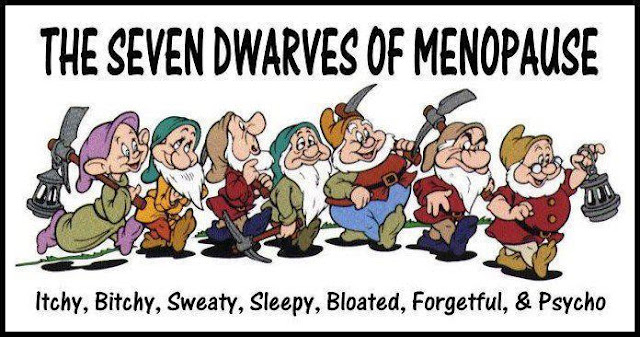
seven-dwarves-menopause-funny-cartoon

When Is A Side-Plate Not A Side-Plate?

According to Wiki, a side-plate (sometimes also called an appetiser plate, a dessert plate, a breakfast plate or a salad plate) can vary from 4 to 9 inches (10-22cm) across. Clearly if you are going to have a go at the Side-Plate Diet, size is a crucial point, although hopefully any side-plate is smaller than a normal dinner plate which you would otherwise be eating off. I have pretty much always eaten lunch and dinner on a normal dinner plate, on top of which (being a fairly greedy kind of gal) giving myself as much food as my husband (Mr Bee, who runs 6 miles a day and works full-time). The psychology of this fascinates me: I am pretty sure I felt that I ‘deserved’ as much food as he was getting. But we all know that women need fewer calories than men, on top of which there is the ever important aspect of Calories Out which I touched on in the first blog. More of that later.

The beauty of the Side-Plate Diet is this: you used to eat amount every day off bigger plates. By eating off a small plate, you are cutting down on portion size and, so long as you are not putting a large slice of coffee and walnut cake onto that side-plate, this will definitely mean fewer Calories In. Bingo. Weight loss.

Back to plates: according to Google, in the 1960s, dinner plates were roughly 9 inches in diameter. In the 1980s, they grew to around 10 inches. By the year 2000, the average dinner plate was 11 inches in diameter, and now, it’s not unusual to find dishes that are 12 inches or larger. I imagine in the 1950’s these would have been called a platter, and yet, here we are putting our dinners on them. No wonder we are piling on the pounds. I was out with a colleague a few weeks ago who, on seeing my medium-sized coffee (not the large, the size of which resembles a soup bowl) said we are now dealing with American sizes, even for coffee. She is right. A large Coke, at the cinema for example, is enormous – way too much surely.

By changing the portion size you change the amount you consume. No counting, no faddy protein-only, fruit -only, fat-free, juice -only; no meal replacements, no weighing your food, no supplements. Many of these diets (and I have tried a few) are unsustainable; you will get an initial weight loss but where are you 4 months down the line or, more to the point, 12? They are hard to make work in the office, or eating out. With the Side-Plate Diet you eat  exactly what you would have been eating, but on a small (I would suggest 7 inch) side-plate.

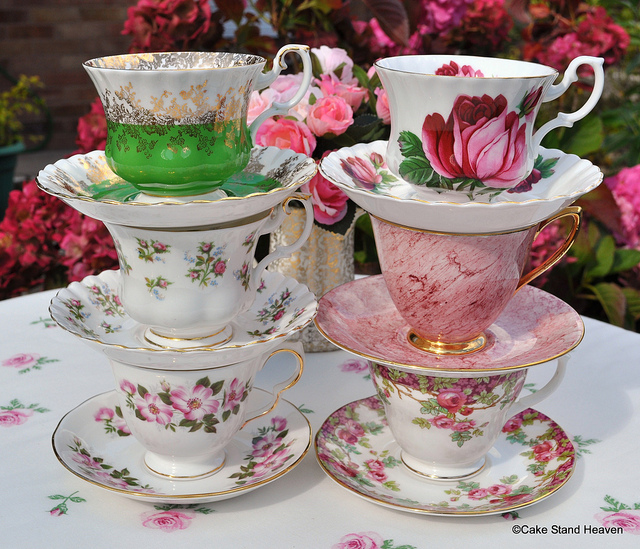
In my house we have blue Denby crockery (it is sturdy, practical and virtually indestructible) and it has done a very fine job for us for the last 15 years, but I like the idea of eating off pretty, maybe vintage, (maybe very modern  – depending on my mood) side plates. You do need to be careful of the size though. I looked at some from John Lewis, but when I read the dimensions closely, although called a side-plate, they were much bigger than 7 inches across.

What about breakfast I hear you say? What about soup? I use little dipping bowls.  original_set-of-four-japanese-dipping-bowls6110184745_54d485544a_z

  Alternatively you could use a vintage tea-cup. Just don’t use a normal sized bowl. Remember: portion control. The other fascinating benefit I have found is that by putting these plates and bowls out first thing in the morning, psychologically I know where I stand. It is those plates, no others. Nothing in between. I do not spend my time thinking about food, as I have parameters in which to stay – those plates. It works for me; let me know if you try it and how you get on and do send in your pics. 

Thanks for reading. Let me know how you get on.

green bee for signature copy

ANNIE BEE x

https://uk.pinterest.com/buzzanniebee/side-plates/

The Side-Plate Diet: The Background

Most of us who are even slightly overweight are aware that, although no doubt a  complex area from a medical/nutrition point of view, our weight comes down to Calories In, Calories Out. As a neighbour of mine pointed out once, when I had exclaimed about her marvellous weight-loss (and rather put me in my place), “it’s not rocket science”.

Indeed it is not, and yet why do so many of us struggle with our weight? And I do not just mean middle-aged women like me; obesity (the description of which, on the NHS website, is  ‘somebody who is very overweight, with a lot of body fat. It’s a common problem, estimated to affect around one in every four adults and around one in every five children aged 10 to 11 in the UK’) is one of the biggest problems facing the long-term health of the population in the UK today.

The Guardian recently reported, “The UK has higher levels of obesity and overweight people than anywhere in western Europe except for Iceland and Malta, according to an authoritative global study that raises fresh concerns about the likely health consequences”. And from The Lancet: ” Because of the established health risks and substantial increases in prevalence, obesity has become a major global health challenge. Not only is obesity increasing, but no national success stories have been reported in the past 33 years. Urgent global action and leadership is needed to help countries to more effectively intervene.”

We know that the Calories Out bit is to do with burning the fuel which is our food; also not a simple issue (we are all different with different abilities, different metabolisms and definitely different levels of motivation) but essentially we all know we need to be ACTIVE. (The additional health benefits impact on our chances of getting cancer, dementia and a whole host of problems).

For the purposes of this piece, it is the Calories In bit which I want to share some ideas with you about. We are bombarded with information on healthy eating, diets, fitness regimes, super-foods etc. I went onto Amazon UK and found there were in excess of 131,000  diet books to be had  – it is mind-boggling to think how much more information is out there on the internet about the subject. How may different diets can you name? How many have you been on? Has the weight-loss been maintained? (If the answer to that last question is ‘yes’, well done). Has a diet you have been on left you feeling weak and pathetic rather than strong and healthy?

To make things simple I have devised the Side-Plate Diet: no calorie counting, no eating different things from the rest of the family, no need for bizarre ingredients (unless that is what makes you tick), but rather finding the “Golden Mean” –  the desirable middle  ground between the extremes of deficiency (not enough food) and excess (over-eating).  Healthy eating but with portion control at the forefront of the approach. I came across one diet (which no doubt has its avid followers and no doubt works for some people) which seems to use little ladles of different colours in which foods must be weighed, added up before being turned into a meal (not to mention you have to buy these cute little ladles). By limiting yourself to a set number of side-plates per day, being sensible (yes, I know, a Mars Bar fits very nicely onto a side-plate – the occasional treat is OK but this is a diet), and sticking to nutritious, balanced foods, you avoid the danger of over-eating and, very importantly (a problem for so many of us and certainly me) snacking.

Research has long highlighted  that people who keep a record of what they eat and drink and how active they are – known to health professionals as ‘self-monitoring’ have more weight-loss success. With the Side-Plate Diet I would urge you to keep a photo diary every day: unless you are a Luddite, chances are you, or somebody who lives in your house, will have access to a digital camera (preferably on your mobile phone). By taking pictures of the plates, you can see just how well you are doing but also analyse whether you are still managing to get enough fruit and veg, what the level of carbs are (it is easy to think that a piece of toast fits well onto a side plate and make that the basis of your meals) but also share what you are eating with others (including me). If taking pics is a problem, write it down.

My next piece will be “What Exactly Is A Side-Plate” – you probably think that sounds mad, but let me tell you, size matters! Also coming soon: Being Active, Portion Distortion, Calories Out.

Thanks for reading.

green bee for signature copy

ANNIE BEE X