Hello. My Name Is Annie And I Am A Coeliac (or is that Celeriac?)

Several years ago I was chatting to the manager in my local large supermarket about the very emotional issue (if you are a coeliac) of gluten free bread, and he said, “Oh yes, I know it must be terribly hard for you celeriacs”. I didn’t have the heart to correct him as he looked so earnest, but have to say that as the years have gone by, the understanding of coeliac disease (hard enough to spell, let alone live with) and the offending protein, gluten, has improved hugely. Gluten free (gf) foods are now readily available here in the UK and many restaurants have menus which are fully labelled, taking the stress out of eating out. I was out for lunch recently here in Hertfordshire though and the waitress gleefully told me she would bring me the Allergy Information Pack which turned out to be a 100 paged, closely- typed scientific report which I then had to cross-reference against the menu. Jolly helpful you might think, but by the time I had found things I liked the sound of, checked whether the tick meant it was gf or contained gluten, and finally checked if it was on that day’s lunch menu, I had lost my appetite and was stressed by the whole palaver, as was Mr Bee. All coeliacs will know this problem well. Worse though is the waiter who says, “Yes I am sure that will be fine” but comes back 10 minutes later with the type of comment which makes a coeliac shudder: “the risotto contains rice, so you can’t have that”. If that is the level of their knowledge, cast aside your napkin and RUN.
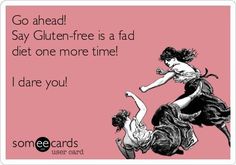
gf ee card

Some very lovely people I know eat a gluten free and/or wheat free diet for health reasons, even though they may not technically have this auto-immune disease (or at least have not been diagnosed). I vividly remember one waitress in a restaurant literally rolling her eyes when I told her I couldn’t have gluten (another picky eater) so I do sometimes feel like wearing a little badge which says ” REAL Coeliac” and I always, without fail now refer to it as “Coeliac Disease” when talking to people in a restaurant, cafe or shop. There does seem to be good evidence now of what is called ‘Non-Coeliac Gluten Sensitivity’ (NCGS) so we RCs (Real Coeliacs) need to embrace our brothers and sisters. The more the merrier.

There are so many lovely blogs, websites and books for coeliacs now. When you are at home, you can eat like a king. Travelling abroad has its challenges but you can print off information about the disease in loads of languages these days which at least cuts down on the chances of mistakes being made.

It is no picnic being coeliac, but there are MUCH worse problems to have.

If you want a good, in-depth article on these matters, try this:  http://www.theguardian.com/lifeandstyle/2015/feb/25/gluten-free-diet-life-saving-fad

Thanks for reading. There are a few more pics here: 

green bee for signature copy

Annie Bee x

It’s Prestigious To Be Busy + Walking

I was listening to Ruby Wax being interviewed on Radio 4 last weekend  – an exhausting woman  (I was driving at the time and almost had to pull over and have a little rest)  – and she said, “It is prestigious to be busy these days” and she did not mean it kindly. So true. If you are not standing up (Sitting Down Is The New Smoking) you risk becoming a social pariah. I hear there are people lap-topping away on a treadmill as I write (attached to a string around their neck, like glasses perhaps?).

What’s it all about?

As I mentioned in a previous post about Calories In, Calories Out, you will know (we all know) that activity is very important to helping and maintaining weight-loss, and combining exercise into your life is the best way of doing this. Every magazine/newspaper  I read tackles the subject ceaselessly  and it is a very big business (in the UK alone the diet business is thought to be worth £2bn). You might be sick to death of hearing about it, but the great news for all of us, but particularly for women over 50, is that walking is fine.This information is from The Guardian :

“Brisk walking reduces the risk of heart disease more effectively than running when the energy expenditure of both activities is balanced out, a study has found.

Researchers compared data from two studies of 33,060 runners and 15,045 walkers. For the same amount of energy used, walkers experienced greater health benefits than runners.

The effects on participants, who were aged 18 to 80, were observed over a period of six years.

Running reduced the risk of heart disease by 4.5% while walking reduced it by 9.3%.

Calorie for calorie, walking also had a stronger impact on heart disease risk factors. The risk of first-time high blood pressure was reduced by 4.2% by running and 7.2% by walking.

First-time high cholesterol risk was lowered by 4.3% by running and 7% by walking.

The risk of first-time diabetes was reduced by about 12% by both walking and running.

“Walking and running provide an ideal test of the health benefits of moderate-intensity walking and vigorous-intensity running because they involve the same muscle groups and the same activities performed at different intensities,” said study leader Dr Paul Williams, from the Lawrence Berkeley National Laboratory in California.

“The more the runners ran, and the walkers walked, the better off they were in health benefits. If the amount of energy expended was the same between the two groups, then the health benefits were comparable.

“People are always looking for an excuse not to exercise but now they have a straightforward choice to run or to walk and invest in their future health.”

The research is reported in the American Heart Association journal Arteriosclerosis, Thrombosis and Vascular Biology”. 

This is fabulous news for people like me for whom The “R” Word (as my beautiful friend Christine used to call it) does not tend to fit into their daily list of exercise. But we can all have a brisk walk and indeed very recent research from the University of Cambridge suggests that just 20 minutes a day has a big impact http://www.theguardian.com/lifeandstyle/2015/jan/14/scientists-recommend-20-minute-daily-walk-premature-death

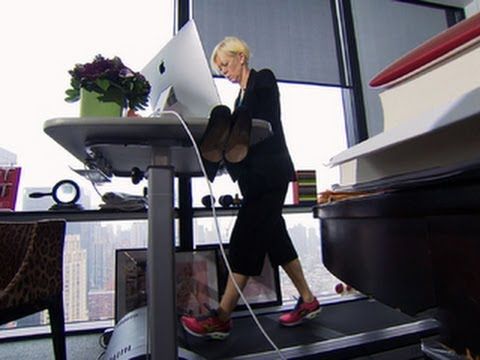
Hooray! Cancel my order for that treadmill for the study; no need to pretend that I can see a computer screen while on the move. And have a good look at Ms Beckham’s shoes below. Someone needs to have a word. It will end in tears.

treadmill work 2    treadmill pic

And finally, I can highly recommend the Nike+Running App (ignore The “R” Word) https://itunes.apple.com/gb/app/nike-gps/id387771637?mt=8.  I use it mainly to check how far I have gone and it keeps a record of the walks which I find very motivating.
Happy walking!

green bee for signature copy

Annie Bee x

https://uk.pinterest.com/buzzanniebee/exercise-work/

When Is A Side-Plate Not A Side-Plate?

According to Wiki, a side-plate (sometimes also called an appetiser plate, a dessert plate, a breakfast plate or a salad plate) can vary from 4 to 9 inches (10-22cm) across. Clearly if you are going to have a go at the Side-Plate Diet, size is a crucial point, although hopefully any side-plate is smaller than a normal dinner plate which you would otherwise be eating off. I have pretty much always eaten lunch and dinner on a normal dinner plate, on top of which (being a fairly greedy kind of gal) giving myself as much food as my husband (Mr Bee, who runs 6 miles a day and works full-time). The psychology of this fascinates me: I am pretty sure I felt that I ‘deserved’ as much food as he was getting. But we all know that women need fewer calories than men, on top of which there is the ever important aspect of Calories Out which I touched on in the first blog. More of that later.

The beauty of the Side-Plate Diet is this: you used to eat amount every day off bigger plates. By eating off a small plate, you are cutting down on portion size and, so long as you are not putting a large slice of coffee and walnut cake onto that side-plate, this will definitely mean fewer Calories In. Bingo. Weight loss.

Back to plates: according to Google, in the 1960s, dinner plates were roughly 9 inches in diameter. In the 1980s, they grew to around 10 inches. By the year 2000, the average dinner plate was 11 inches in diameter, and now, it’s not unusual to find dishes that are 12 inches or larger. I imagine in the 1950’s these would have been called a platter, and yet, here we are putting our dinners on them. No wonder we are piling on the pounds. I was out with a colleague a few weeks ago who, on seeing my medium-sized coffee (not the large, the size of which resembles a soup bowl) said we are now dealing with American sizes, even for coffee. She is right. A large Coke, at the cinema for example, is enormous – way too much surely.

By changing the portion size you change the amount you consume. No counting, no faddy protein-only, fruit -only, fat-free, juice -only; no meal replacements, no weighing your food, no supplements. Many of these diets (and I have tried a few) are unsustainable; you will get an initial weight loss but where are you 4 months down the line or, more to the point, 12? They are hard to make work in the office, or eating out. With the Side-Plate Diet you eat  exactly what you would have been eating, but on a small (I would suggest 7 inch) side-plate.

In my house we have blue Denby crockery (it is sturdy, practical and virtually indestructible) and it has done a very fine job for us for the last 15 years, but I like the idea of eating off pretty, maybe vintage, (maybe very modern  – depending on my mood) side plates. You do need to be careful of the size though. I looked at some from John Lewis, but when I read the dimensions closely, although called a side-plate, they were much bigger than 7 inches across.

What about breakfast I hear you say? What about soup? I use little dipping bowls.  original_set-of-four-japanese-dipping-bowls6110184745_54d485544a_z

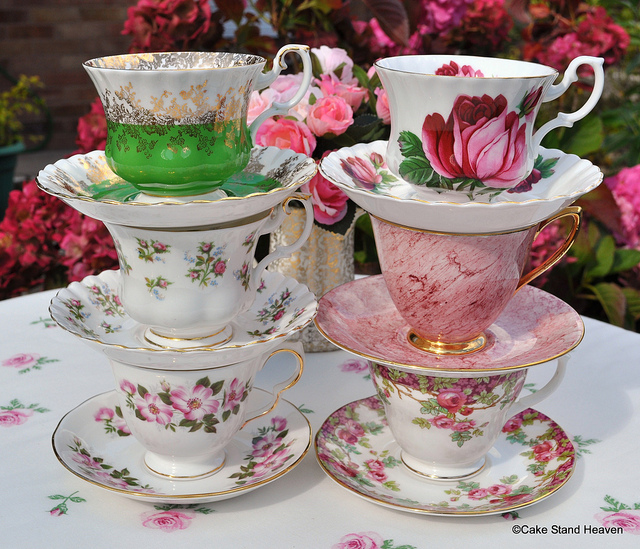
  Alternatively you could use a vintage tea-cup. Just don’t use a normal sized bowl. Remember: portion control. The other fascinating benefit I have found is that by putting these plates and bowls out first thing in the morning, psychologically I know where I stand. It is those plates, no others. Nothing in between. I do not spend my time thinking about food, as I have parameters in which to stay – those plates. It works for me; let me know if you try it and how you get on and do send in your pics. 

Thanks for reading. Let me know how you get on.

green bee for signature copy

ANNIE BEE x

https://uk.pinterest.com/buzzanniebee/side-plates/

The Side-Plate Diet: The Background

Most of us who are even slightly overweight are aware that, although no doubt a  complex area from a medical/nutrition point of view, our weight comes down to Calories In, Calories Out. As a neighbour of mine pointed out once, when I had exclaimed about her marvellous weight-loss (and rather put me in my place), “it’s not rocket science”.

Indeed it is not, and yet why do so many of us struggle with our weight? And I do not just mean middle-aged women like me; obesity (the description of which, on the NHS website, is  ‘somebody who is very overweight, with a lot of body fat. It’s a common problem, estimated to affect around one in every four adults and around one in every five children aged 10 to 11 in the UK’) is one of the biggest problems facing the long-term health of the population in the UK today.

The Guardian recently reported, “The UK has higher levels of obesity and overweight people than anywhere in western Europe except for Iceland and Malta, according to an authoritative global study that raises fresh concerns about the likely health consequences”. And from The Lancet: ” Because of the established health risks and substantial increases in prevalence, obesity has become a major global health challenge. Not only is obesity increasing, but no national success stories have been reported in the past 33 years. Urgent global action and leadership is needed to help countries to more effectively intervene.”

We know that the Calories Out bit is to do with burning the fuel which is our food; also not a simple issue (we are all different with different abilities, different metabolisms and definitely different levels of motivation) but essentially we all know we need to be ACTIVE. (The additional health benefits impact on our chances of getting cancer, dementia and a whole host of problems).

For the purposes of this piece, it is the Calories In bit which I want to share some ideas with you about. We are bombarded with information on healthy eating, diets, fitness regimes, super-foods etc. I went onto Amazon UK and found there were in excess of 131,000  diet books to be had  – it is mind-boggling to think how much more information is out there on the internet about the subject. How may different diets can you name? How many have you been on? Has the weight-loss been maintained? (If the answer to that last question is ‘yes’, well done). Has a diet you have been on left you feeling weak and pathetic rather than strong and healthy?

To make things simple I have devised the Side-Plate Diet: no calorie counting, no eating different things from the rest of the family, no need for bizarre ingredients (unless that is what makes you tick), but rather finding the “Golden Mean” –  the desirable middle  ground between the extremes of deficiency (not enough food) and excess (over-eating).  Healthy eating but with portion control at the forefront of the approach. I came across one diet (which no doubt has its avid followers and no doubt works for some people) which seems to use little ladles of different colours in which foods must be weighed, added up before being turned into a meal (not to mention you have to buy these cute little ladles). By limiting yourself to a set number of side-plates per day, being sensible (yes, I know, a Mars Bar fits very nicely onto a side-plate – the occasional treat is OK but this is a diet), and sticking to nutritious, balanced foods, you avoid the danger of over-eating and, very importantly (a problem for so many of us and certainly me) snacking.

Research has long highlighted  that people who keep a record of what they eat and drink and how active they are – known to health professionals as ‘self-monitoring’ have more weight-loss success. With the Side-Plate Diet I would urge you to keep a photo diary every day: unless you are a Luddite, chances are you, or somebody who lives in your house, will have access to a digital camera (preferably on your mobile phone). By taking pictures of the plates, you can see just how well you are doing but also analyse whether you are still managing to get enough fruit and veg, what the level of carbs are (it is easy to think that a piece of toast fits well onto a side plate and make that the basis of your meals) but also share what you are eating with others (including me). If taking pics is a problem, write it down.

My next piece will be “What Exactly Is A Side-Plate” – you probably think that sounds mad, but let me tell you, size matters! Also coming soon: Being Active, Portion Distortion, Calories Out.

Thanks for reading.

green bee for signature copy

ANNIE BEE X